On 19 February 2026, the 11th The MAN Conference was held at the House of Human Rights in Belgrade – an international expert platform dedicated to contemporary masculinities and policies for working with boys, young men, and men. After a five-year break, the conference was relaunched by Centar E8 and the regional network Younng Men Initiative -YMI, with the support of CARE Balkans.
The conference was opened by Sara Dereta on behalf of CARE Balkans and Vojkan Arsić on behalf of Centar E8, who emphasized that young men today are growing up in a complex global context marked by political radicalization, anti-gender narratives, and the strong influence of digital platforms. It was highlighted that identities are no longer shaped exclusively within families and schools, but also in algorithm-driven online spaces that often amplify polarizing and toxic content. In such an environment, systemic and long-term work with boys and young men is more urgent than ever.
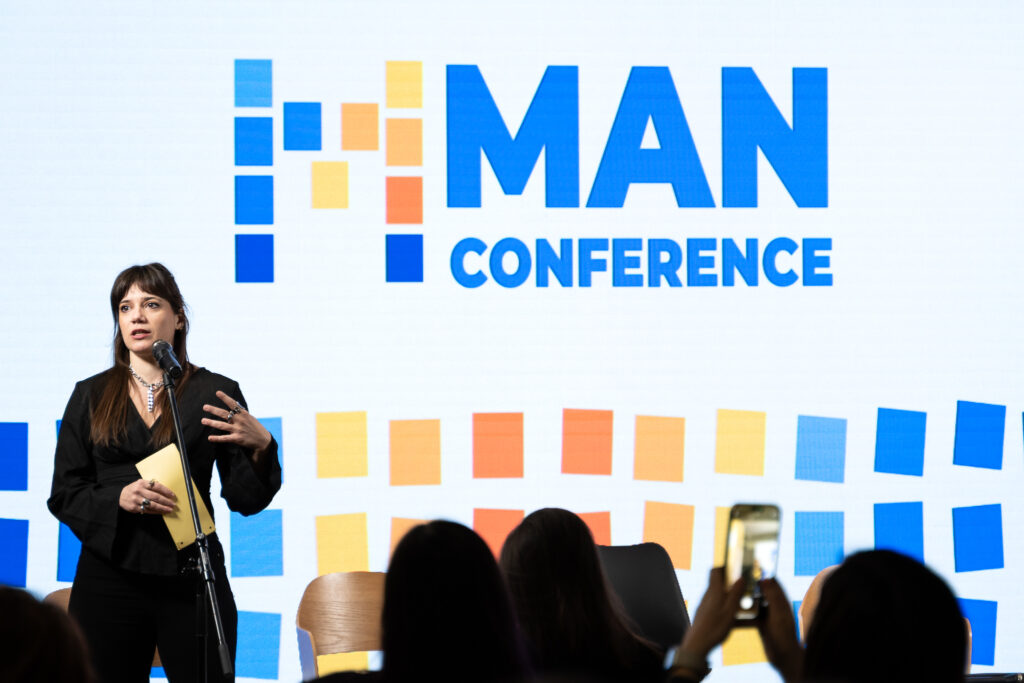
The conference program included several thematic panels and discussions with national and international experts in the fields of gender equality, education, youth work, media, and public policy.
In the panel on boys’ development, Maja Dimitrijević, representative of CARE Balkans, spoke from the perspective of implementing regional youth programs, drawing on nearly two decades of experience with Program Y and the Young Men Initiative. As an organization that has been developing and implementing gender-transformative programs across the region for almost twenty years, CARE Balkans sees work with young men as one of the key strategies for preventing violence and strengthening healthy social norms.
Speaking about the development of positive models of masculinity, Maja Dimitrijević emphasized the importance of emotional literacy: “In traditional models of masculinity, anger is often the only ‘allowed’ emotion. When young people lack the capacity to express fear, sadness, or insecurity, frustration often translates into aggression.”
She pointed out that peer violence is not an isolated incident, but rather a product of norms that link masculinity with force, control, and dominance, and that changing these norms is a long-term process requiring engagement with individuals, peer groups, schools, and local communities.
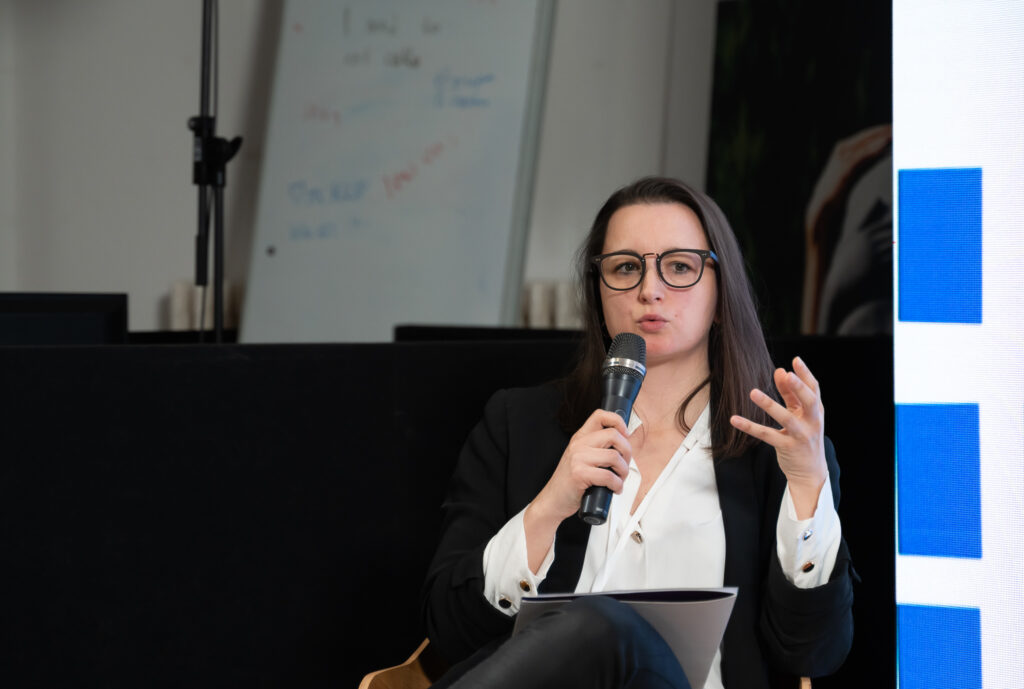
The panel also included Nevena Petrović from the “Sveti Sava” Gymnasium; Biljana Jovanović from the Center for the Protection of Infants, Children and Youth – Head of the “Moša Pijade” Home for Children without Parental Care; and Đorđe Radojević, trainer and youth worker from Centar E8. The panel was moderated by Tijana Pavlović, Coordinator of the Gender Equality Program at Centar E8. Participants emphasized that violence prevention must begin much earlier than current public policies recognize, and that boys often lack safe spaces to express vulnerability. Particular attention was given to work with at-risk youth and youth work tools aimed at building trust.
The discussion on masculinity and extremism was led by Balbon Niklas from the Otto Suhr Institute for Political Science in Berlin and Teodora Šulj, journalist at Zoomer.rs. It was noted that radical movements offer young men a sense of belonging and identity clarity, which is why prevention efforts must include understanding the needs of young men, not only security measures.
The panel on masculinity and contemporary crises was opened by Henri Myrttinen from the Berlin-based organization Gender Associations, with contributions from Adnan Kadribašić (Impact, Sarajevo), Helena Vuković (L*communio, Novi Sad), and Andrej Ševo (Institute for Philosophy and Social Theory). The discussion was moderated by Nađa Duhaček from the Center for Women’s Studies. The debate highlighted how feelings of threat are often used to reinforce authoritarian models of masculinity, but also how crises can create opportunities for transformation toward models based on care, solidarity, and responsibility.
The discussion on masculinity and ecology featured Zorana Antonijević and Iva Marković from the Center for Political Ecology – Polekol, opening important questions about the relationship between male identities and environmental responsibility.
The final panel on digital spaces and the manosphere was opened by Gary Barker, founder of Equimundo, whose programs are implemented in more than forty countries. The discussion included Hristina Cvetičanin Knežević (“Feminizam iz teretane”), Natko Gereš (Croatian Institute of Public Health), Andrija Stokić, and Milan Nikolić (Insajder Television), and was moderated by Minja Bogavac from Centar E8. It was emphasized that the manosphere offers young men a sense of belonging and identity, and that alternative programs must provide meaning, community, and clear values, without misogyny and radicalization.
The 11th The MAN Conference reaffirmed that masculinity is one of the key social issues of our time. For CARE Balkans, investing in work with boys and young men represents a long-term strategy for preventing gender-based violence, strengthening gender equality, and safeguarding democratic values in the region. Through regional cooperation and a systemic approach, we continue to develop programs that provide young people with support, tools, and space to build healthy, non-violent, and equitable models of masculinity.
Donor: Marie Eberth Stiftung
Partner Organization: Center E8







Supported by